
A blind hole is a hole that does not completely penetrate the component and therefore has a certain depth. Blind holes are used when the material thickness of the workpiece is very large or drilling through is not necessary. In addition, a through-hole may not be desired or possible for structural reasons.

Fasteners for blind holes
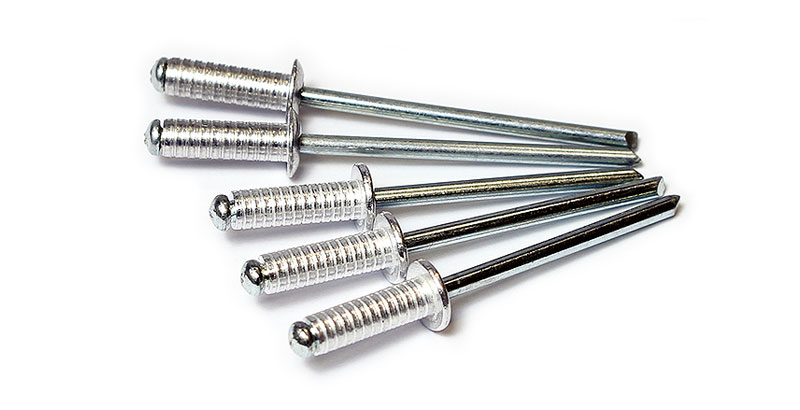
Grooved blind rivet ALFO
The ALFO version with grooved rivet shank is perfectly suitable for blind holes. In this case the grooves claw into the environmental material of the bore hole. Please take care of the following instructions:
- Determination of the drilling diameter by trial
- Min. hole depth t = rivet length including mandrel head minus assembly part
- Indicated forces refer to the rivet forces have to be determined by trial.

Hammerdrive blind rivets
Hammer drive blind rivets are set simply by driving the rivet mandrel into the rivet sleeve.
Parts with through-hole or blind end borehole can thus be riveted.
A wide range of material combinations are possible. Typical applications are to be found in the construction industry for fastening, for example, claddings or insulation, profile strips, sheets and angle brackets. For blind boreholes, a trial is necessary in order to establish the optimum rivet length based on the component characteristics and the strength requirements.