Process monitoring in fastening technology

Process monitoring Honsel DMSD 2G

DMSD has stood for process monitoring in fastening technology for more than 30 years. HONSEL received its first patent for process monitoring in blind rivet processing back in 1990.

The new second generation DMSD 2G process monitoring is a consistent further development, since industrial requirements have been increasing constantly for the last few years.

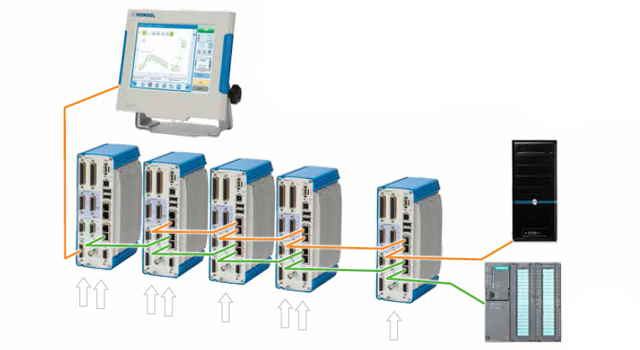
Almost all HONSEL standard tool components such as RivSys BZ & VNG, automated solutions, work stations and hand tools for rivet nuts, blind rivets and coils can be connected to the DMSD 2G.

New measurement transducers which require a faster sampling rate, parallel and faster data processing and new networking options are the characteristics of the newly designed DMSD 2G.

DMSD 2G

The measurement recording module can be connected to the display module via a connecting cable with a maximum cable length of 5 m.

Alternatively, the measurement recording module (MEM) is directly connected to the display module (DIM).

Almost any distance between the modules can be realised by incorporating DIMs and MEMs in a company-provided Ethernet.

  • In-process monitoring of joining and assembly procedures.
  • Early detection of quality deviations in the manufacturing process.
  • Minimisation of QA effort.
  • Transparency in the production process leads to faster feedback.
  • Traceable process results.
  • Reduction in additional test routines.

Advantages

Up to 8 measurement recording modules can be connected to a display module for extended application cases.

When using a VNC viewer, applications can also alternatively be implemented without a display module.

  • Connecting facilities for measurement transducers with different output signals from DMS to incremental and piezo-measurement transducers without additional amplifiers.
  • The resolution of the stroke measurement is 0.01 mm. This therefore complies with the VDA demand for 10 times resolution when recording with regard to the evaluation.
  • The facility for monitoring maximum force and two additional control windows has been supplemented by two freely parametrisable control windows, even to the extent of envelope curve monitoring. It is possible to valuate up to 10 evaluation elements in one measuring program.
  • It is possible to evaluate up to 10 evaluation elements in one measuring program.
  • Up to 108 measuring programs can be stored in the monitoring.
  • Up to 20 master programs are available for the monitoring.
  • Parametrisation and programming take place via the firmware installed in the controller – no additional program is required.
  • Operation and remote maintenance are possible using VPN tunnels via a VNC viewer, meaning that the operator can see what is being carried out via the remote maintenance. With the remote maintenance you can see which actions are being carried out by the operator. A large monitor can be attached via the VNC viewer.
  • The measurement evaluation module (MEM) can be used with a display module (DIM) or also without a display module as a black box module.
  • Up to 8 MEMs can be connected to a DIM.
  • 4, 5 or 9 MEM evaluation windows can be displayed simultaneously on a DIM.
  • As well as the last process values, a history of the previous setting processes can be called up via the MEM.
  • The process monitoring measuring programs and settings can be stored on a USB storage medium, from where they can also be restored.
  • The process values can be archived on USB storage media or on a server via Ethernet (USB storage medium, server or QDAS).
  • The process values can be stored in Q-DAS, XML, CSV, PDF, QDA-9 or IPM 5.0 format. Process values stored in CSV format can be subjected to further processing using Excel.
  • A scanner for recording the components can be directly attached to the MEM. If a scanner is incorporated, the code that is read in is also stored, making tracking possible.
  • Connection to a customer controller is possible via digital inputs and outputs and via a field bus (PROFINET, PROFIBUS DP and EtherCAT).

Example of connecting facilities with a handheld tool

  1. Hand scanner
  2. USB storage medium
  3. Server
  4. Digital input (5x) und output (8x)
    1. PROFINET
    2. EtherCAT
    3. PROFIBUS DP
  5. eBZ smart-tool connection by WiFi
  6. Pneumatic setting tool
Process monitoring DMSD 2G connecting facilities for handheld tools

Example of connecting facilities with an automation system

  1. Machine control with PLC via digital inputs and outputs or field bus
  2. Sensor system for process monitoring
  3. Communication: PLC <-> MEM via digital inputs or outputs or field bus
Connection possibilities for automated setting tools

Connection between MEM and programming user interface

  1. MEM fitted directly to DIM (piggyback).
  2. Distance between DIM and MEM up to 5 m via cable.
  3. Operation with DIM via Ethernet.
  4. Operation with VNC viewer on machine control unit via Ethernet.
  5. Operation with VNC viewer on PC via Ethernet.
  6. Remote maintenance via Internet and VPN.
Connection options for the recording module.

Setting tools with process monitoring

processing blind rivets
RivSmart eBZ ZERO DMSD

  • Operating type: Battery
  • Stroke: 20 mm
  • Working power: 6.800 N
  • Weight: 1.3 kg (incl. battery)
  • max. mandrel-ø: 3.4 mm
  • Blind rivets aluminium: 2.4 - 4.0
  • Blind rivets steel: 2.4 - 4.0
  • Blind rivets stainless steel: 2.4 - 4.0
  • Blind rivets copper: 2.4 - 4.0

processing blind rivets
BZ 101A DMSD 2G

  • Operating type: Pneumatic-hydraulic
  • Pressure: 5 - 7 bar
  • Stroke: 17 mm
  • Noise: < 95 db(A)
  • Working power: 11.500 N
  • Weight: 2.0 kg
  • max. mandrel-ø: 3.6 mm
  • Blind rivets aluminium: 2.4 - 5.0
  • Blind rivets steel: 3.0 - 5.0
  • Blind rivets stainless steel: 3.0 - 5.0
  • Blind rivets copper: 3.0 - 5.0

processing blind rivets
BZ 121A DMSD 2G

  • Operating type: Pneumatic-hydraulic
  • Pressure: 5 - 7 bar
  • Stroke: 21 mm
  • Noise: < 95 db(A)
  • Working power: 18.000 N
  • Weight: 2.5 kg
  • max. mandrel-ø: 4.2 mm
  • Blind rivets aluminium: 4.0 - 8.0
  • Blind rivets steel: 4.0 - 8.0
  • Blind rivets stainless steel: 4.0 - 6.4
  • Blind rivets copper: 4.0 - 6.0

processing blind rivet nuts
VNG 802 DMSD 2G

  • Operating type: Pneumatic-hydraulic
  • Pressure: 5 - 7 bar
  • Stroke: 7 mm
  • Noise: < 92 db(A)
  • Working power: 29.000 N
  • Weight: 2,7 kg
  • Blind rivet nuts aluminium: M4 - M10 (optional M12)
  • Blind rivet nuts steel: M4 - M10 (optional M12)
  • Blind rivet nuts stainless steel: M4 - M10 (optional M12)
  • Blind rivet studs steel: M4 - M8

Cookies

We use cookies to enable you to make the best possible use of our website and to improve our communication with you. We take your preferences into account and process data for analytics and personalization only if you give us your consent by clicking on "Agree and continue". You can revoke your consent at any time with effect for the future. Please consider the references of our  privacy policy.

Show details

Your cookie preferences for this website

We use cookies to enable you to make the best possible use of our website and to improve our communication with you. Make your personal preference here:

Required cookies help to make a website usable by enabling basic functions such as page navigation and access to secure areas of the website. The website cannot function properly without these cookies.

Individual cookies

Cookie name: cookiebar; Provider: HONSEL; Purpose: This cookie stores the user's consent status to cookies; Duration: 1 year; Privacy policy

Cookie name: gtm_*; Provider: Google LLC; Purpose: Used to load and manage other services such as Google Analytics or conversion tracking via Google Tag Manager; Duration: up to 2 years; possible data transfer to the USA

Individual cookies

Cookie name: uslk_*; Provider: Userlike; Purpose: Used to show website chat and save status of the chat; Runtime: 1 year